Sunday, June 17, 2012

May 28, 2012 Butterfly Monitoring

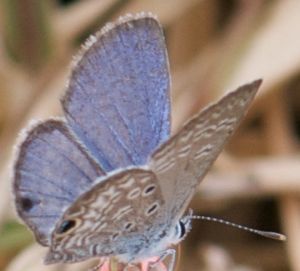
The 2012 Memorial Day holiday followed tropical storm Beryl in our area, and that's when we went out for our monthly Butterfly Monitoring survey on May 28.  There was very little blooming in the Guana Dam transect (Transect A), but we did see a variety of butterfly species including the Horace's Duskywing (Erynnis horatius) (Hesperiidae family), Cassius (Leptotes cassius) and Ceraunus Blues (Hemiargus ceraunus) (Lycaenidae family) and Palamedes Swallowtail (Papilio palamedes) (Papilionidae Family). 
Ceraunus Blue

Horace's Duskywing

Palamedes Swallowtail 

Thursday, April 19, 2012

April 16, 2012 Butterfly Monitoring

The winds were calm and the sun was bright with clear skies.  We have had extremely dry weather the past month. Without the rain, there is very little flora blooming.  The freshwater marsh appeared very dry - no water was visible behind the tall grasses.  
Few butterfiles were spotted this morning, but among them were the Variegated Fritillary (Euptoieta claudia) nectaring on the few gallardia blooms that are planted near the kiosk overlooking the freshwater marsh along the yellow trail, in our Transect B.  
We usually see the Gulf Fritillary, (Agraulis vanillae) not the Variegated. 
Variegated Fritillary
Gulf Fritillary
Eastern Pygmy Blues (Brephidium pseudofea) were seen at the Salicornia Transect C.   
This is our smallest butterfly.  One of the blues with a wing span less than one inch.
Eastern Pygmy Blue
The Miami Blue Butterfly (Hemiargus [Cyclargus] thomasi bethunebakerihas), reduced to a few hundred survivors on isolated islands off Key West, was formally declared a federally endangered species on April 6, 2012.
We have not seen a Miami Blue within the GTM NERR Butterfly Monitoring transects, in the three years of our surveys.  
Once common in the southern coastal areas of Florida, the Miami Blue butterfly was eliminated from much of its former range due to ever-expanding urbanization and the associated loss of coastal habitat. In the years following Hurricane Andrew, researchers feared that the butterfly may have become extinct as no verified sightings were recorded. Fortunately, the Miami Blue was rediscovered on November 29, 1999, as part of a small population of less than 100 individuals within the boundaries of Bahia Honda State Park in the Lower Florida Keys. 
Miami Blue
Miami Blue
The Great Southern White (Ascia monuste) has been plentiful this week in the Coastal strand and dunes; and a few of them were also here by the Estuary and the Upland hammock in our four transects.  The Great Southern White has distinctive turquoise antennae clubs.  Spanish needleis a favorite nectar plant 

Great Southern White

Saturday, April 14, 2012

March 19, 2012 Butterfly Monitoring

On March 19, 2012 on a warm day with calm breezes, after a weekend of similar weather, the first butterfly spotted on the trail transect B was a Northern Cloudywing (Thorybes pylades) sitting on the ground and so well camouflaged against the brown leaves. This species is in the Skipper Family (Hesperiidae).

The hammock was full of fluttering Viola's Wood-Satyrs, Megisto viola. This is typical for April, but March is early for them. This butterfly is in the Brush-foot Family (Nymphalidae). Adults have a slow bouncing flight and will rise as far as the tops of tall trees. Males patrol in the shade to find females. Eggs are laid singly on grass blades, which the caterpillars eat. Adults nectar on wood sap, rarely flower nectar.  We counted 88 of this species in our transects, but there were hundreds more along the trails outside the boundaries of our transects.

We discussed other "bugs" along the way.  
Did you know: A bee is an herbivore, a wasp is a carnivore.

We saw two Eastern Pygmy Blues (Brephidium pseudofeain) in the glasswort (salicornia) transect C.  This is their preferred habitat, near saltwater in coastal marshes and tidal flats, and the glasswort is a host plant.  Our transect is not soaking wet this year, as it was last year.  We did not count any of the species last year.  Today they were observed resting with their wings closed on the glasswort, tiny and looking brown in color, but when they open their wings the blue highlights are visible. Males patrol low over the host plants in search of females. Flight is weak and slow. Adults nectar on palmetto palm and saltwort (Batis maritima) flowers.  This species is of the Blues and Hairstreaks Family (Lycaenidae).


We also counted salt marsh skippers in this transect. Skipper Family (Hesperiidae).
This species is more commonly seen in Transect A at the water's edge.

In transect D, the Red Bay transect, we again observed many Viola's Wood Satyrs.  

We also counted more than 20 Palamedes (Papilio palamedes) in transects B and D.  This butterfly is in the Swallowtail Family (Papilionidae). They nectar on the thistle which was plentiful today, especially in Transect B.  
We also saw a resurgence of Red Bay (Persea borbonia) saplings; this species of tree is a host plant for the Palamedes.  We have wathced the red bay trees dying in this transect over the last few years, due to the fungus left by the invasive ambrosia beetle. 


Tuesday, December 20, 2011

December 16, 2011 Butterfly monitoring

December 16, 2011 
Butterfly monitoring at Transect A (from the Environmental Education Center to the Trailhead, on both sides of the road - along the estuary and along the lake, passing the dam.)


A calm and clear day.  So many birds at the dock and on the water!
In Guana river, little fish heads were popping out of the water.  
We believed them to be juvenile flounder.


There are a few Spanish needle (Bidens alba) blooms and some Indian blanket (Gaillardia pulchella)) but overall very few blooms.  Some thistle popping up but not blooming.  East of the dam was recently mowed.


We saw the Common Buckeye (Junonia coenia) on dried grass, and the Phaon Crescent (Phyciodes phaon) on the Spanish needle.  These are in the Brush-foot Family (Nymphalidae).


Common Buckeye
Phaon Crescent
Two Ceraunus Blue (Hemiargus ceraunus) with wings closed resting very still for a long time, and two Cassius Blue (Leptotes cassius), also at rest on the dried out grass.  These species are of the Blues and Hairstreaks (Lycaenidae) family.
Ceraunus Blue

Cassius Blue


As we headed east on the lake side, the wind picked up suddenly.  
  

Tuesday, November 29, 2011

November 2011 Butterfly Monitoring

November 2011 Butterfly Monitoring
Transect A - From the Environmental Education Center to the Trailhead


More birds than ever on the dock - pelicans, gulls and cormorants.  
Tall grasses were plentiful along the edge of the marsh.  Also goldenrod and salt wort. 


We spotted a Tropical Checkered Skipper (Pyrgus oileus) basking.  We had previously seen one in June, but more often we see the Common Checkered Skipper.
Tropical Checkered Skipper
Common Checkered Skipper


There were Gulf Fritillary (Agraulis vanillae) near shade trees and burned wood and dry grasses,  as well as two Common Buckeye  (Junonia coenia).  
Gulf Fritillary Wings Open

Gulf Fritillary Wings Closed


A Ceraunus Blue (Hemiargus ceraunus) was opening and closing its wings, very blue/purple with open wings. They have low and erratic flight patterns. 
Ceraunus Blue


Frog fruit (Phyla nodiflorawas) also known as Carpetweed, was blooming with lots of runners and Phaon Crescent (Phyciodes phaon) butterflies fluttering about, and resting with wings opening and closing as they rested. 


Good biodiversity today, with an American Lady (Vanessa virginiensis) and two Monarchs, of the Brush-foot family (Nymphalidae),  a Fiery Skipper (Hylephila phyleusand) a Long-tailed Skipper (Urbanus proteus). 

American Lady Wings Open

American Lady Wings Closed
Fiery Skipper

Long-tailed skipper


The male Monarch Butterfly may be easily distinguished from the female by noting the two highly visable black spots on the insect's hind wings and the thinner black webbing within the wings. The female's webbing is thicker and she has no identifying wing spot as the male does.
Female Monarch

Male Monarch